Friday, January 27, 2012

La vida en fotos

 
Here's a video of traditional hegi dancing at an agricultural fair in the town of Salto Dupí, where another volunteer lives. A voice is describing the dance, then enters into a traditional song. There are many different types of hegi dances, of which I only know a couple. The Feria was a fun chance to travel to another town and see the work there! About a dozen volunteers showed up for the event on Jan 15 which included sales of artisan crafts, vegetables and agricultural products from the Organic Producers' Association (which the PC works with), home cooked meals, and a dance in the evening. Volunteers, Ngabes, and children danced together late into the night at this dry event, a very special occasion in a culture where the tradition is to get smashing drunk at all celebrations.

I put a number of new photos on my Picasa (see right side of page) with notes. Take a look through them!

My house is finished as well, though I have yet to move in. Here's a slideshow of the rest of the construction process.

Wednesday, January 11, 2012

El nuevo año empieza (the new year begins)


Preparing food for the church´s Christmas celebration

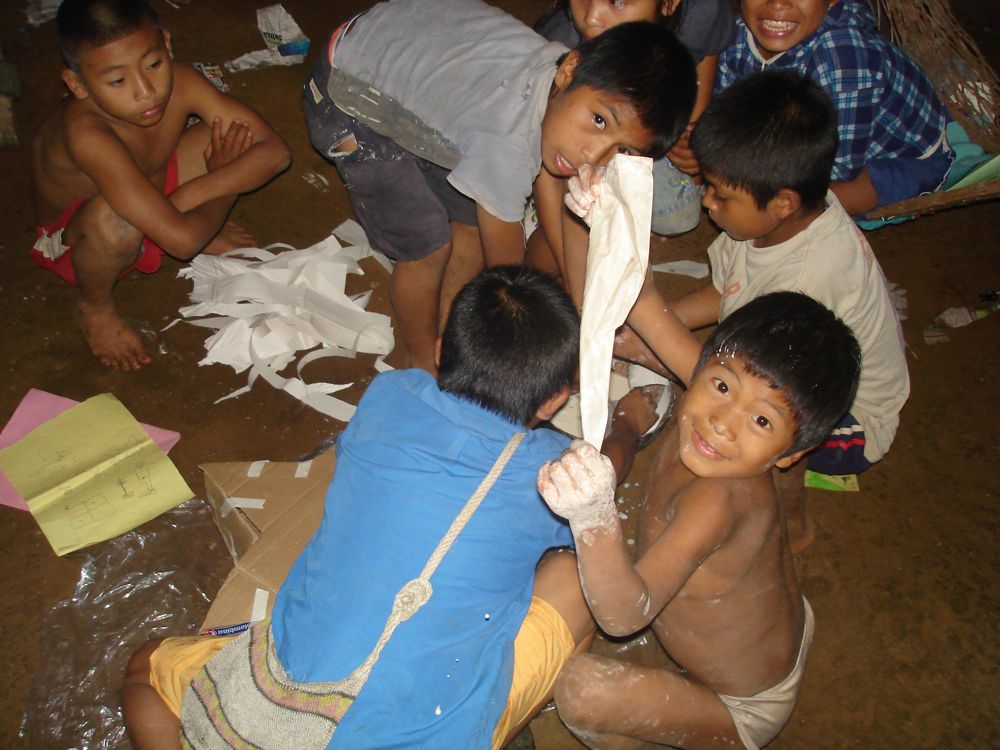
Finishing making the piñata for another Christmas celebration in the community

The piñatas were a smashing success, both of them, in two separate Christmas parties. After 8 days of work, we finished the house. Party to come this Friday, complete with traditional dancing that some older community members are putting together.  I hope to get my wooden latrine seat put together tomorrow so that part of the facility can be open to inspection and use! 

The next task, something I´ll be working on in the next 2 months, is to do a survey of the community, all 28 households. The survey I´ve designed should provide some baseline data before we start any programs, as well as start more conversations about community health.  I´ve also got a checklist (standardized with the other Environmental Health projects) about things I´ll just observe. For example, in their house I´ll look for  how they store their drinking water.

Some example survey questions and my thinking behind them:

What are the names and ages of household members?

Most community members are children and teenagers, with a sprinkling of grandparents. One person pointed out what the presence or absence of elderly indicates for health. Average family size is likely around 5 kids.  In the earlier generation, polygamy was common. The two main family groups, upper and lower sections of the community, are each originating in a patriarch with several wives. There are a few complicated situations with second marriage in the present day, and one man with two wives. Due to the influence of outsiders, in the form of increased education and efforts of Christian missionaries, few women are interested in a polygamous marriage nowadays. They used to get married early in the old days, and quite a few still do.  One friend got hitched at age 15 and had her first child at 16, with a man 15 years older. I don´t know how she could have had discretion at that age to make a good choice but she seems to have made it- the father is a hard worker and devoted to the family. I need to look past my own prejudices and filters to understand and empathize with people in a situation very new to me. Many volunteers teach seminars for teenagers using  a PC developed curriculum about life choices and sex education, to start addressing these important issues.  The sheer numbers can speak to how many people a latrine or aqueduct project could serve in the present day, and make projections about the growth of the community. 

For what reasons might you go to the health center? The curandero (traditional healer)? What do you treat in the home?

Community members will often treat things in home that I would go running to a health center for- an infected pus pocket on a child´s face, a nasty two week long cold, persistent diarrhea and lack of appetite.   I don´t understand this, but I think it has something to do with keeping power in the home vs taking them to an outside source where any of the following may happen: absent doctor (come back later), they may have to wait in lines, spend money, or experience disrespect from staff.  Many people will wait an illness out and see if it worsens. Not so bad in our site where an ambulance can drive up at midnight to evacuate if need be, but in more remote communities waiting to seek treatment may have disastrous consequences.

How many cases of diarrhea has your family experienced in the last 3 months?

Often caused by unwashed hands or dirty water.  As far as I can tell, they think all diarrhea is caused by foods that don´t agree with the stomach, or don´t mix well together. 

Where do you go to the bathroom?

The most sensitive question on the survey, and one that some other Volunteers have found easiest to have an accompanying community member ask. I am expecting, for the most part, one of two answers: in the monte (hills or fields) or the quebrada (creek). Many Ngabe communities prefer to wash rather than wipe, which has been an obstacle to latrine introduction. There are some water based (pour flush) latrines used in the developing world but   they are much more expensive.  I am feeling out the attitude of the people in the community; several disused latrine pits speak to the complexity of the issue.

Friday, December 23, 2011

Ngabe Navidad

My town- my host family house is on the right
I've been thinking about relationships and connectedness lately. A Boston friend takes comfort in the fact that the same moon is shining over her loved ones on the other side of the world. I think of that sometimes. Of greater comfort is that the same God is Lord of all. And in this season we celebrate the coming of Emmanuel, God with us, in the person of Jesus. The God of the Bible is not a distant creator who set the laws of the universe in motion and then left it alone, but a Person who desires to have relationships with his creatures just as we desire relationships with each other. We are invited, at Navidad (Christmas) to worship Jesus as King,  in a form as small and fragile as a human baby.
Baby blanket, stitched by Florentina, my host mom

My parents are a constant support for me, even offering to send me socks from the US as a Christmas present. (Thanks, but no thanks).  Sometimes I take their support for granted, but I am really blessed to have them. As well as all the extended family and friends that pray for me and read this blog.

Ken is the guy at home. We've been dating for nearly a year now, and long distance since August. Had I entered the Peace Corps in February 2011 as I was expecting to, we wouldn't be having long cell phone conversations. I'm grateful to be living in this age of cell phone and internet communication because otherwise, this connection would probably be impossible. While life as a Harvard grad student is very different from life in the campo, we try to share our experiences and pray through the events of the week. Distance has slowed down and changed the way we interact, but we've been growing in friendship.


My community is all about connections. My weekly trips to town have been my alone time- because in my community of Alto Nube my days are one continuous social interaction. That's a big change from my life in the states, which was often solitary and punctuated by social engagements.

We are starting to construct a house for me to live in & rent for the next 2 years, and to be used by any Volunteers that may come after me as well.  A large team of people- men, women, and children- have been working to transform trees and living materials into a house.  On our first work day we had 28 people, and we've had 3 work days so far. Our first task was to cut 20 large stalks of bamboo, each of which was cut into 2 sections of about 15 feet long for carrying.  We carried them somewhere between half a mile and a mile, on a muddy footpath on our shoulders. The 10 year old boys, accustomed to carrying water and firewood, surpassed me in strength! The next day the team went in search of posts and beams for the house: sturdy trunks of laurel and palm trees. Also, we harvested "penca", palm thatch. Meanwhile another team split the bamboo into strips to use as siding. The posts were buried in the ground, to form corners, windows, and a door. My house will be a 14 by 14 foot square, half of which (7 by 14 ft) will be enclosed in bamboo with a corrugated metal roof, and the other half an open air porch roofed with palm thatch. Labor and most of the materials for the house are being donated by the community, as well as a significant amount of food and firewood for our work parties.  I just show up to work and provide most of the food. The work is their gift of cooperation and of friendship. Another gift that I must receive with gratitude.


In my community itself, they're not throwing much of a Christmas party- there's not the resources this year to have a celebration as they sometimes do.  After talking with Ken about a subdued Christmas eating rice and beans ("ka ulire," sad times), I realized I'm in a position to invite people to celebrate. It'll be small scale- a homemade piñata and hopefully some games.  On Christmas day I'll be going to church.
Piñata construction


About a month ago I mentioned a little girl, Melissa, who was severely sick with pneumonia. She recently returned after over a month in the hospital and looks great. In times of need the whole extended family chips in to provide. Here she is (in the blue dress) with her mom and cousin.  Something to be thankful for, indeed.

Wednesday, December 7, 2011

Diciembre, esta pegando verano! (It´s turning summer!)

Tomorrow is Mother´s Day here in Panama!  And summer is just about here! It´s like I´m in a time warp… is this really December?

Florentina ( my host mom) and I successfully baked cornbread and chili on our fogon cookfire!  We used my recipes from the States. We used a small pot placed inside a larger, covered pot, to create a buffer of hot air around the baked goods.  This was the first time Flora has done any baking.  Some other communities make a coconut flavored yeast bread, but not here, it seems.


Here I am wearing my new nagwa dress, with friends Franklin and Marceliano.

We had a second community meeting on Nov 26. This time we included an additional half dozen houses located above the road which divides the community into Arriba and Abajo, Upper and Lower. The lower community is larger and it organized to bring me here, but the upper section is also interested in collaborating. We discussed my role here, their expectations, and shared some ideas. We had a good discussion that went on until it clouded over and the rains came (predictably) in the early afternoon. We shelved for a future meeting one of the activities I´d planned, making a seasonal calendar, but all in all it went very well with positive attitude and a great turnout of 28 adults.  In the coming weeks I´ll continue doing analysis activities with small groups and designing a house to house survey with some members of the community.  


presenting a community map done at the previous meeting

Ladies´side. In meetings people typically informally group by gender.
We are also making preparations to construct a house for me to live in for the remainder of my time here. As I write from town, my backpack is heavy with nails for the work! We will be tentatively starting construction with cutting the wood and bamboo for siding during the week before Christmas. The group is very motivated and I appreciate that so much! 

Tuesday, November 29, 2011

Gracias!

As a follow up to my last post, what I find most disorienting are not the outright strange or different things, but the interactions that are just slightly different, like a different organization of goods at the market or not understanding the dressing room attendant in the department store. 
Thanksgiving dinner
I spent Thanksgiving with a group of 16 other Volunteers in David: my training group. We have now been just over a month in our work sites! Spirits were generally good, despite one person with diarrhea and another with giardia, which required a hospital stay. It was fun to check out the stores and restaurants in David, the second largest city in Panama and the provincial capital of Chiriqui.  We ate Thanksgiving dinner at an Italian restaurant and enjoyed sharing lots of stories from our month apart.

With a Thanksgiving theme, some of the things I'm thankful for are:

  • The cell phones and the internet that connect me with loved ones and friends far away and nearby.
  • A group of other volunteers to share this experience with.
  • A community that's friendly and excited about working with me.
  • The generosity of that community, even when it seems they have so little.
  • The beautiful natural world that I live and work in.
  • My own access to financial resources and opportunity, which is far beyond that of my community here (this disparity is not something to be thankful for, of course, but I am thankful for what I do have.)
  • The presence of churches in my area, including one that I think I'd like to continue attending (after visiting most of them).
  • I pray that God would increase my understanding of the Gospel, that I would be more thankful to Him for all he's given me, and for the way he's redeemed this life.
  • Finally, I'm thankful that my community has good access to a road and government-run medical facilities:

A little girl in my community is sick with severe pneumonia, and is in the hospital with a tube in her side. It's a good thing she's in the hospital and receiving, we hope, the best of medical care. It's too bad the family didn't take her earlier, but they thought, as did I, that it was a severe chest cold. While I'm working in health, I'm not trained in medical care and it's humbling.

On a different topic entirely, the economy works in really interesting ways here.  People are connected to each other and the outside world in many complex ways. It's going to take a long time for me to understand more fully what's going on, but here are some of the ways my family gets by:

In- the current season's agricultural crops

Rice, Yucca, Coffee, Cacao, Otoi (root vegetable), Squash, Bananas, Plantains, Chickens

In- money

Govt welfare (dependent on the kids' enrollment in school and the health center)
Selling coffee, cacao, and chickens informally to neighbors
Work for pay on others' farms (a few days here and there)
Sewing dresses (on a hand cranked machine)- something many women in the community do

In- Sharing

The grandmother, who works in a distant town as domestic help, sent plantains and smoked beef one day.

Outlays- I have a very incomplete picture here.

Food
Supplies such as soap, matches, string
School supplies, uniforms
Clothing
Travel
Sharing food with other families
Expenses related to medical care (the care itself is subsidized)

People in my community also practice several handicrafts:

Some women in the community make "chackras," net bags. They start by twisting cordage, either out of unravelled plastic rope, or natural fibers (which is a whole process of preparation unto itself). Then the bags are crocheted, either by hand or using a crochet hook, depending on the size. It's very labor intensive. Bags are used for firewood, babies, bananas, purses, and cell phones, in descending order of size.
This is a giant bag for firewood! Or maybe just for show... imagine an old lady twisting this cordage on her thigh, to make the rope that this bag is made out of! Dyed with natural "tintas."

A handful of men in the larger community make sombreros, also out of natural fibers. This is traditionally men's work, while the chackras are women's work.

To make the distinctive dresses, "nagwas",  ladies generally use hand crank or foot pedal operated sewing machines. Quite a few of them have a side business of sewing clothes to order for other families.  I really like the dresses and I ordered one for myself, which turned out really nicely... I hope to have a few. I hope to take a picture soon of me wearing it.

Tuesday, November 15, 2011

Enjoying "normal"

Iguanas, reported to be quite tasty (haven't tried yet)
It hit me when I walked into the supermarket. I breathed a sigh of relief. Sure, I was still in Panama, but things were familiar here, even American.  There was the cereal aisle, over there the vegetable section and the baked goods. This made me very happy, in a way that walking into a Safeway never does in the States.  On other days, I'd been navigating the Panamanian world. When it came to shopping, I wasn't sure what kind of store sold what kind of thing, nor, when I got there, how goods were organized. I realized that I like being in an environment where I know the social and cultural norms.  So, as an estadounidense (United-States-ian) I really like being American.

Some of my many American traits:

Craving and eating vegetables.
Requiring "alone time" to think and process (a foreign idea to the family-oriented Panamanians).
Reading for fun.
Traveling far away from my loved ones and connections to have an adventure of service and self-discovery in another country.

I feel a new respect for immigrants to the US, as well, who may be coming from a very different context, to a new world with a vast array of options to choose from, of decisions to be made on a daily basis.  I and a Volunteer friend were imagining what it would be like for a Ngabe to move to the US. What would they think of us, and how would they manage so far from their family? I think I can never really communicate my US world to them; it's a real privilege to be acquainted with more than one way of life and to share in theirs. Most aspects of Ngabe life are really different from mine in the US: traditional, even ancient in some cases. Other aspects are just the same- many Panamanians have cell phones too, for example. To me, the cell phone feels like an interloper from my other life, something that doesn't belong here with the palm thatch huts and the chickens. But I'm glad that we both have phone access.

I've received some questions about my diet, so I'd like to share a bit of that so-important part of my day. I eat with my host family.   We eat rice, fried or boiled bananas, white yams, and yucca. These starches are topped with chicken, egg, greens, instant soup, squash, or beans. I bring dried beans, spices, and vegetables from town every 10-14 days to supplement what the family grows.  The family also grows coffee and chocolate, which they prepare and drink themselves or sell informally to neighbors. I'm actually eating a better variety of foods than I did in my training period (a typical meal was rice or spaghetti with chicken in a ketchup sauce).  Food for the most part is plentiful but if a meal falls between the cracks I eat from a secret stash of peanut butter and crackers.

Bush Meats I've tried (generous, hunter neighbors)
Don't worry, this conejo pintado is a pet... I ate a different one.

Conejo Pintado, or Paca
Wild Boar
Deer

New Fruits & Vegetables in Panama

Nance- small, cherry like fruits with a tart flavor, reminds me of rhubarb
Pifa- palm nuts, dry with a tasty, meaty flavor
Custard Apple- a fruit with oddly gooey, white flesh
Bananas- Some really tasty banana varieties which we don't see in the States.
Chayote-  summer squash; you can eat the leaves too.
Zapayo- pumpkin-like squash
Boda- a wild flower, harvested in the woods when it's still in the bud.
Cacao-  cacao + water is the traditional, and ritual drink, though coffee is more common everyday now.

I'll close with a few photos:
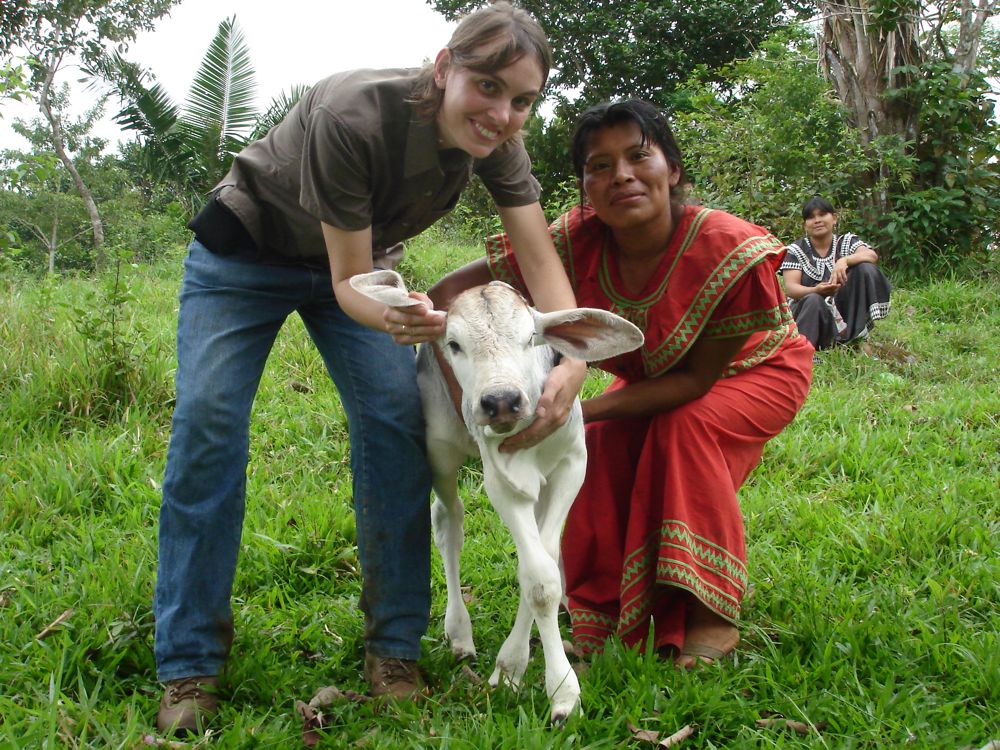
The family cow gave birth on Sunday Nov 13.

Baby calf, several hours old


Making an "organic pesticide" with local teacher & environmentalist Regina and agriculture volunteer Winston

Creating a map  of the community with a group of men and a group of women, a step in my community analysis

Drawing a map with a different section of my community
Harvesting coffee with my host family
Harvesting my host family's coffee. These are "coffee cherries"- the bean is inside a fleshy fruit

Wednesday, November 2, 2011

Ti blite Ngabere chi. (I speak a little Ngabere)


Well, my first week on the job has been interesting!

My first host mother, Chabi, has been outside the community working in the city. Consequently we moved up the timeline to move into my second host family house:  this involved constructing a latrine, a shower enclosure, and a room within their one-room house. 


I expect to be living with the host family through Jan or Feb. As there are no spare houses available to rent here, the plan is that the Water Committee will build me a home to rent for the remainder of my stay. The Peace Corps requires that we live with host families for the first  3 months.  I'm looking forward to having more of my own space, schedule, and diet. Still, like my host family during training, they are more than accommodating and very glad to have me.  The immediate family consists of father Mindo, mother Florentina (about my age), two grade school boys, Alvaro and Omar, and baby Ede. The community as a whole consists of a couple of extended families and  they, and I, are frequently visiting other homes. The work party's effort to build my new accommodations was very encouraging for me. It also felt humbling to accept it as a gift.

My host family, Mindo and Florentina Montero, with children Omar and Ede. Not pictured is 10 year old Alvaro.


I had the chance to visit one of several area churches this Sunday, a Baptist church with the service partly in Ngabere and partly in Spanish. It was encouraging to meet with other believers, though the service felt disorganized for me. I followed along in my Bible as the sermon was in Ngabere, and they were using the Ngabe Bible.  I hope to visit other churches in the coming weeks and choose one to attend regularly. Earlier in the week I chanced upon a missionary trio, two Panamanian Kuna (another indigenous group) and an American, that were there to support the local Baptist church's efforts.  It was neat to meet them as well!

At the same time I'm learning a little bit about the syncretistic religion, Mama Chi, practiced by some members of my community. I don't know much yet; but the traditional rituals are more frequently in the "summer" which starts in December.  Also there is a "curandero" or traditional medicine/plants healer who lives in the upper section of the community.  I pray that I will be able to walk well in a complex mixture of cherished cultural rituals, spiritual, and health practices.  Understanding what's going on here is going to take time and "confianza": confidence, or trust.

On October 28 we had a festival day in the large town nearby. Many schools' percussion marching bands competed.  Everyone turned out in their finest clothing, some of it made or purchased for the occasion.


Three other volunteers from the wider area were able to attend: Erica and Emma from my training group, and Carolyn who has been here one year.  We are all environmental health workers.
Susan, Carolyn, Emma, Erica

Here we are: some wearing the traditional dresses, nagwas. I have a chackra, a net bag made from natural cordage.  I'm ordering my own nagwa this coming week from a seamstress in the community. Little girls have been asking, "why don't you wear a nagwa?" They are beautiful and striking.


The community continues to be pleased that I am making an effort to learn their language.. as small as my current vocabulary is. Heaven knows there's a lot to absorb.  This past week has been mostly visiting around the community to know people better. There's a community meeting on Saturday Nov 5 as well, and my work here is part of the agenda.


To close, here are a couple of pics from Panama City, two weeks ago when we were there for swearing in.  Panama City is an interesting mix of "first world" skyscrapers, cultural attractions, shopping, and slum neighborhoods.