Friday, March 9, 2012

ñänä nire (hot sun)

Hello friends! Happy March! For those who remembered me on my 29th birthday with emails and cards, thank you! I spent the day with community members- at a church Bible study where I brought some stovetop banana-oat cookies, and later making popcorn with my neighbors.

Neighbor Federico and his puppy Lobita "little wolf"


Thank you to all of you who’ve been praying for the protests and unrest in Panama. Negotiations about mining and hydroelectric continue, and the atmosphere is watchful and waiting. Since that first week-long protest things have been much calmer. But the threat of protests, and police response to them, is still present. Groups of indigenous Ngabe are standing by the side of the highway keeping watch, ready to block the road if called upon to do so.

March is springtime in the States but in Panama it’s the height of “summer”, the dry season. It feels a lot more like August with scorched grass and blazing sunshine (in Ngabere, that’s “ñana nire”, hot sun). Summer is also the time of school vacation but now kids are heading back to school in their freshly pressed blue and white uniforms and government assigned backpacks. The teachers are back, after several months’ absence for vacation, commuting to and from our neighboring town’s school in the back of a covered pickup truck that serves as our bus.

The groundwater continues to dry up in summer. In the last 3 months the quantity coming from our principal spring has halved each month. I measure it every month with a group of kids as willing helpers. Knowing how much water is flowing in summer is essential information should we want to do an aqueduct, a piping system, in the future. And now is the time of the year to get the most helpful data. We assume according to WHO guidelines and Panamanian’s water use that 30 gallons a day is needed per capita.

March is also significant for me for a couple other reasons: my boyfriend Ken is visiting me here in the second week of March for his spring break. We’ll be spending some time at my site and also at a tourist resort/hostel. After months of talking on the phone as our main communication, we’re really looking forward to this visit!

Once he leaves, I’ll be joining the other volunteers in my training group, those that started with me in August, for a week of classes near Panama City. We’ll be sharing our community analyses with each other and learning how to plan projects and write grants. In the process of preparing my analysis including my health surveys, I’ve learned some interesting things about my community:

There are around 190 residents in 28 houses, plus me! This is more than I’d realized.
7 of those houses, or 25% have constructed and use their own latrines. The rest go in the bushes.
The median number of children for mothers to have is 5.5. Family planning is rarely used though it is readily available at the health center.
Out of 190 people, fully half are under age 15, and only 6 are older than age 60. Life in the Comarca is hard on the body.

The most common illnesses are
Intestinal worms (everyone has them always, though some times are worse than others)
Colds and flu
Diarrhea
Headaches and migraines.

Most people visit the traditional healer first when they get sick, and the doctor second. They take pride in their culture including the traditional medicine.

The worms and diarrhea are problems based on unclean water and poor sanitation- in short, when we ingest poop it makes us sick. This means that the job the PC has trained me to do, is very relevant for my community.

In April, when I get back from my training, I’m going to share the results with the community in a general meeting. We’ll talk about their needs and priorities and decide what programs and projects we want to tackle first. The community puts a lot of trust in me, assuming that I know what I’m doing! I am learning a lot and hope to be worthy of that trust. Often the Peace Corps will send several volunteers in a row to a location- not just 2 years in a site but 4 or 6 years of PC presence.

Man makes a traditional hat like the one he is wearing. First he makes a braid then sews it together in a coil.


I’ll end with some stories and photos from February (more on my Picasa to the right).

I had the chance to visit a model organic farm in another town. Regina, a friend and elementary school teacher from the neighboring town of Cerro Iglesias, took her family and me on an hour and a half hike to reach Finca Esperanza, Hope Farm. Owner Leandro is an enthusiastic proponent of all things organic. He gave us a tour of his medicinal and edible wild plant garden, fish ponds, okra, forest, and compost. He even cultivates a beneficial fungus in a barrel: he sprays a solution of fungus and water on crops like cacao and coffee that are prone to fungal infections. He says the one fungus combats the others. This is new to me! Winston, a nearby agriculture volunteer in Cerro Iglesias, will be doing some work with him in the future. After the farm tour we cooled off with Leandro’s kids by jumping in a beautiful nearby river and hunting crayfish (we only caught some tiny ones).
Leandro and his daughter show off their okra. They use the seeds to make a delicious "coffee."

beneficial fungus


hunting crayfish

Cooling off! I swam in my clothes as did everyone else...


I also visited volunteer Kayla in another Comarca town to help out with some latrines she’s constructing. I learned a lot from how she’d organized her community in work groups to accomplish a large project of 50 latrines! After spending 1 day working with her, I hiked back down the steep hill with Kayla’s friend Eusebio and horse Jaguar, who was carrying a metal mold to make a concrete latrine seat. Kayla didn’t need it anymore and another volunteer did, so we were helping courier it to another location.

A scaffolding of wood, bamboo, and plastic is laid directly over the pit in order to pour the concrete in place.
The horse prefers to ford the stream rather than cross on the bridge, where I'm standing
Eusebio let me hold Jaguar's reins for a photo
Some final photos represent the harvest of guandu, or pigeon peas, a delicious bean that can be harvested green or allowed to dry on the stalk before harvesting. They lay out the dried beans on some plastic and stomp and sort them- the beans themselves fall to the bottom and the pods can be thrown out.


Friday, February 10, 2012

Aguantar, "to endure"

The last week in Panama has been a difficult one. I have been safe, up in my mountain home. But down below there have been country-wide protests that shut Panama down for a week. As a result, the national Assembly is revisiting the mining and hydroelectric laws that are disputed by the Ngabe protesters. We are all waiting to see what will result from the dialogue! Here's an article describing the situation, from Panama's La Prensa newspaper.

Thursday, February 2, 2012

A little excitement

Ngäbe-Buglé close highway in Chiriquí | Locales-Ultima Hora | Prensa.com

The tribe is protesting a proposed copper mine in the Comarca, their reservation. Or more specifically, the laws governing mineral rights. The main and only highway across the country has been closed for 3 days by protesters, and the radios, which are on in every house, blare stories of spoiled produce and pregnant women in the stopped vehicles. Happily where I actually live, in the mountains above the highway, is more calm, or "todo tranquilo" as they say.  Though many community members are down at the protests. Prayers for a peaceful and just resolution to a long standing dispute are appreciated.

On another subject, I'm definitely not an early adapter of technology. Nor is my family, as I typed most of my high school papers on a typewriter. But thanks to the generosity of friends who've donated a smartphone (thanks Ken and Katherine) I am now able to cruise, or rather,  slowly crawl the internet from my mountain village, at least "de vez en cuando," once in a while. Thus I'm able to share this with you today!

Friday, January 27, 2012

La vida en fotos

 
Here's a video of traditional hegi dancing at an agricultural fair in the town of Salto Dupí, where another volunteer lives. A voice is describing the dance, then enters into a traditional song. There are many different types of hegi dances, of which I only know a couple. The Feria was a fun chance to travel to another town and see the work there! About a dozen volunteers showed up for the event on Jan 15 which included sales of artisan crafts, vegetables and agricultural products from the Organic Producers' Association (which the PC works with), home cooked meals, and a dance in the evening. Volunteers, Ngabes, and children danced together late into the night at this dry event, a very special occasion in a culture where the tradition is to get smashing drunk at all celebrations.

I put a number of new photos on my Picasa (see right side of page) with notes. Take a look through them!

My house is finished as well, though I have yet to move in. Here's a slideshow of the rest of the construction process.

Wednesday, January 11, 2012

El nuevo año empieza (the new year begins)


Preparing food for the church´s Christmas celebration

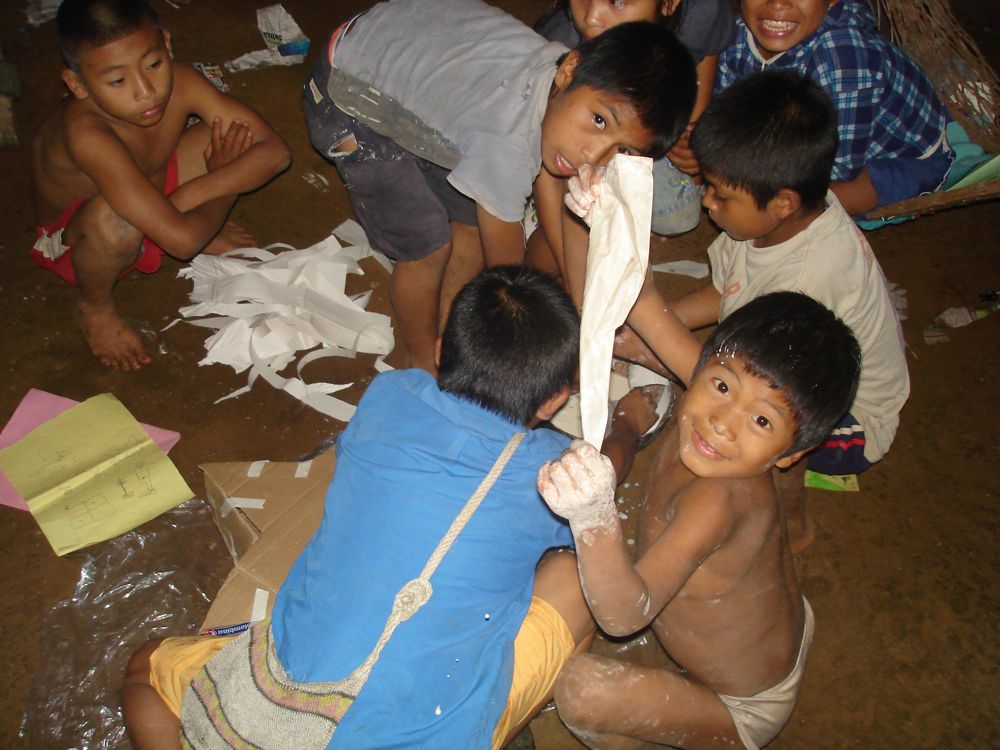
Finishing making the piñata for another Christmas celebration in the community

The piñatas were a smashing success, both of them, in two separate Christmas parties. After 8 days of work, we finished the house. Party to come this Friday, complete with traditional dancing that some older community members are putting together.  I hope to get my wooden latrine seat put together tomorrow so that part of the facility can be open to inspection and use! 

The next task, something I´ll be working on in the next 2 months, is to do a survey of the community, all 28 households. The survey I´ve designed should provide some baseline data before we start any programs, as well as start more conversations about community health.  I´ve also got a checklist (standardized with the other Environmental Health projects) about things I´ll just observe. For example, in their house I´ll look for  how they store their drinking water.

Some example survey questions and my thinking behind them:

What are the names and ages of household members?

Most community members are children and teenagers, with a sprinkling of grandparents. One person pointed out what the presence or absence of elderly indicates for health. Average family size is likely around 5 kids.  In the earlier generation, polygamy was common. The two main family groups, upper and lower sections of the community, are each originating in a patriarch with several wives. There are a few complicated situations with second marriage in the present day, and one man with two wives. Due to the influence of outsiders, in the form of increased education and efforts of Christian missionaries, few women are interested in a polygamous marriage nowadays. They used to get married early in the old days, and quite a few still do.  One friend got hitched at age 15 and had her first child at 16, with a man 15 years older. I don´t know how she could have had discretion at that age to make a good choice but she seems to have made it- the father is a hard worker and devoted to the family. I need to look past my own prejudices and filters to understand and empathize with people in a situation very new to me. Many volunteers teach seminars for teenagers using  a PC developed curriculum about life choices and sex education, to start addressing these important issues.  The sheer numbers can speak to how many people a latrine or aqueduct project could serve in the present day, and make projections about the growth of the community. 

For what reasons might you go to the health center? The curandero (traditional healer)? What do you treat in the home?

Community members will often treat things in home that I would go running to a health center for- an infected pus pocket on a child´s face, a nasty two week long cold, persistent diarrhea and lack of appetite.   I don´t understand this, but I think it has something to do with keeping power in the home vs taking them to an outside source where any of the following may happen: absent doctor (come back later), they may have to wait in lines, spend money, or experience disrespect from staff.  Many people will wait an illness out and see if it worsens. Not so bad in our site where an ambulance can drive up at midnight to evacuate if need be, but in more remote communities waiting to seek treatment may have disastrous consequences.

How many cases of diarrhea has your family experienced in the last 3 months?

Often caused by unwashed hands or dirty water.  As far as I can tell, they think all diarrhea is caused by foods that don´t agree with the stomach, or don´t mix well together. 

Where do you go to the bathroom?

The most sensitive question on the survey, and one that some other Volunteers have found easiest to have an accompanying community member ask. I am expecting, for the most part, one of two answers: in the monte (hills or fields) or the quebrada (creek). Many Ngabe communities prefer to wash rather than wipe, which has been an obstacle to latrine introduction. There are some water based (pour flush) latrines used in the developing world but   they are much more expensive.  I am feeling out the attitude of the people in the community; several disused latrine pits speak to the complexity of the issue.

Friday, December 23, 2011

Ngabe Navidad

My town- my host family house is on the right
I've been thinking about relationships and connectedness lately. A Boston friend takes comfort in the fact that the same moon is shining over her loved ones on the other side of the world. I think of that sometimes. Of greater comfort is that the same God is Lord of all. And in this season we celebrate the coming of Emmanuel, God with us, in the person of Jesus. The God of the Bible is not a distant creator who set the laws of the universe in motion and then left it alone, but a Person who desires to have relationships with his creatures just as we desire relationships with each other. We are invited, at Navidad (Christmas) to worship Jesus as King,  in a form as small and fragile as a human baby.
Baby blanket, stitched by Florentina, my host mom

My parents are a constant support for me, even offering to send me socks from the US as a Christmas present. (Thanks, but no thanks).  Sometimes I take their support for granted, but I am really blessed to have them. As well as all the extended family and friends that pray for me and read this blog.

Ken is the guy at home. We've been dating for nearly a year now, and long distance since August. Had I entered the Peace Corps in February 2011 as I was expecting to, we wouldn't be having long cell phone conversations. I'm grateful to be living in this age of cell phone and internet communication because otherwise, this connection would probably be impossible. While life as a Harvard grad student is very different from life in the campo, we try to share our experiences and pray through the events of the week. Distance has slowed down and changed the way we interact, but we've been growing in friendship.


My community is all about connections. My weekly trips to town have been my alone time- because in my community of Alto Nube my days are one continuous social interaction. That's a big change from my life in the states, which was often solitary and punctuated by social engagements.

We are starting to construct a house for me to live in & rent for the next 2 years, and to be used by any Volunteers that may come after me as well.  A large team of people- men, women, and children- have been working to transform trees and living materials into a house.  On our first work day we had 28 people, and we've had 3 work days so far. Our first task was to cut 20 large stalks of bamboo, each of which was cut into 2 sections of about 15 feet long for carrying.  We carried them somewhere between half a mile and a mile, on a muddy footpath on our shoulders. The 10 year old boys, accustomed to carrying water and firewood, surpassed me in strength! The next day the team went in search of posts and beams for the house: sturdy trunks of laurel and palm trees. Also, we harvested "penca", palm thatch. Meanwhile another team split the bamboo into strips to use as siding. The posts were buried in the ground, to form corners, windows, and a door. My house will be a 14 by 14 foot square, half of which (7 by 14 ft) will be enclosed in bamboo with a corrugated metal roof, and the other half an open air porch roofed with palm thatch. Labor and most of the materials for the house are being donated by the community, as well as a significant amount of food and firewood for our work parties.  I just show up to work and provide most of the food. The work is their gift of cooperation and of friendship. Another gift that I must receive with gratitude.


In my community itself, they're not throwing much of a Christmas party- there's not the resources this year to have a celebration as they sometimes do.  After talking with Ken about a subdued Christmas eating rice and beans ("ka ulire," sad times), I realized I'm in a position to invite people to celebrate. It'll be small scale- a homemade piñata and hopefully some games.  On Christmas day I'll be going to church.
Piñata construction


About a month ago I mentioned a little girl, Melissa, who was severely sick with pneumonia. She recently returned after over a month in the hospital and looks great. In times of need the whole extended family chips in to provide. Here she is (in the blue dress) with her mom and cousin.  Something to be thankful for, indeed.

Wednesday, December 7, 2011

Diciembre, esta pegando verano! (It´s turning summer!)

Tomorrow is Mother´s Day here in Panama!  And summer is just about here! It´s like I´m in a time warp… is this really December?

Florentina ( my host mom) and I successfully baked cornbread and chili on our fogon cookfire!  We used my recipes from the States. We used a small pot placed inside a larger, covered pot, to create a buffer of hot air around the baked goods.  This was the first time Flora has done any baking.  Some other communities make a coconut flavored yeast bread, but not here, it seems.


Here I am wearing my new nagwa dress, with friends Franklin and Marceliano.

We had a second community meeting on Nov 26. This time we included an additional half dozen houses located above the road which divides the community into Arriba and Abajo, Upper and Lower. The lower community is larger and it organized to bring me here, but the upper section is also interested in collaborating. We discussed my role here, their expectations, and shared some ideas. We had a good discussion that went on until it clouded over and the rains came (predictably) in the early afternoon. We shelved for a future meeting one of the activities I´d planned, making a seasonal calendar, but all in all it went very well with positive attitude and a great turnout of 28 adults.  In the coming weeks I´ll continue doing analysis activities with small groups and designing a house to house survey with some members of the community.  


presenting a community map done at the previous meeting

Ladies´side. In meetings people typically informally group by gender.
We are also making preparations to construct a house for me to live in for the remainder of my time here. As I write from town, my backpack is heavy with nails for the work! We will be tentatively starting construction with cutting the wood and bamboo for siding during the week before Christmas. The group is very motivated and I appreciate that so much!